
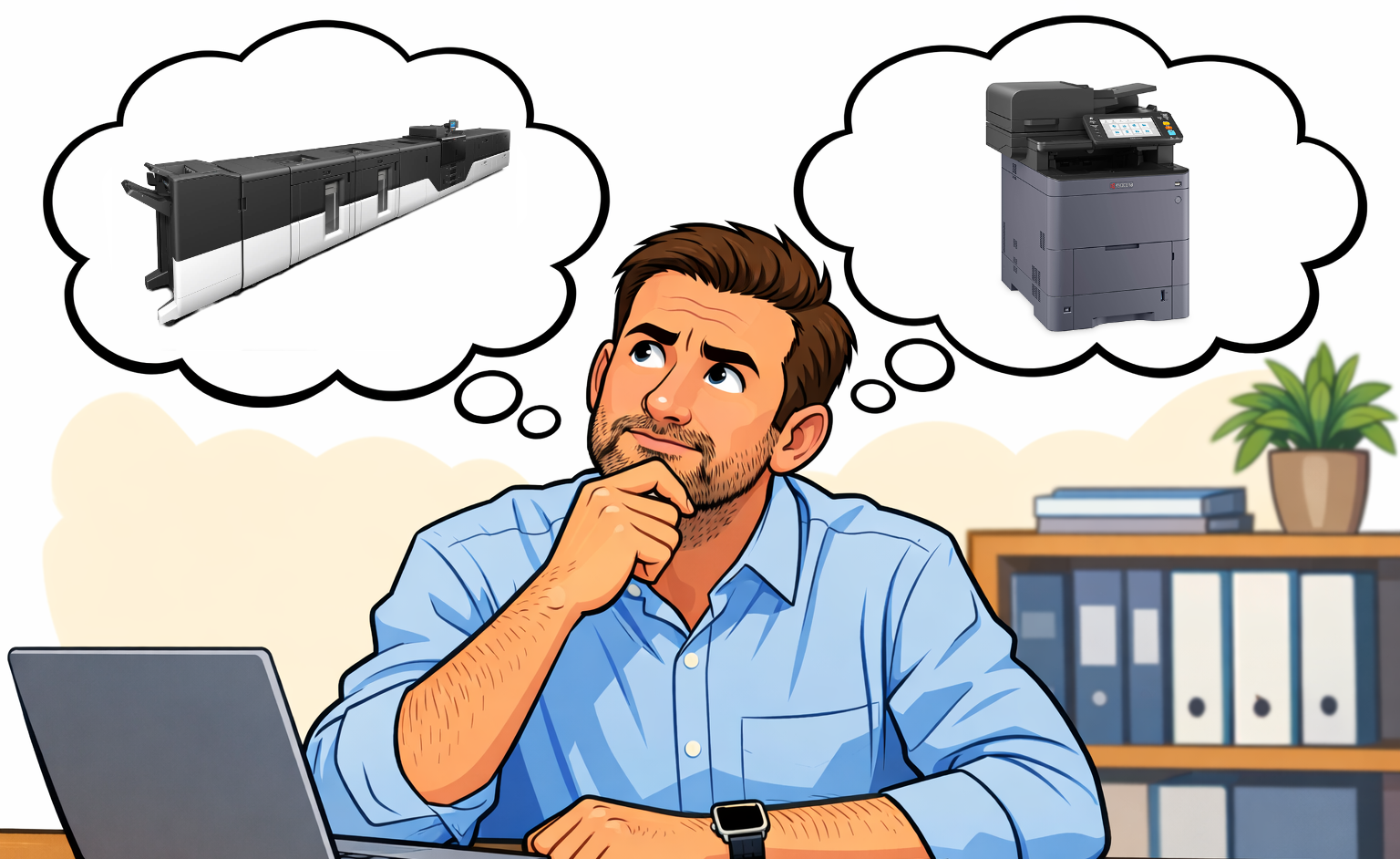
Commercial vs. Consumer Copiers and Printers: What’s the Real Difference?
What’s the actual Difference between a Commercial Grade and Consumer Grade Copier and Printer?
Most businesses don’t set out to buy the wrong printer.
They buy what looks reasonable. Affordable. Familiar. Something that worked fine at home or in a previous job. And for a while, it does work.
Until it doesn’t.
That’s usually when the question comes up:
Do we actually need a commercial-grade copier or printer, or is a consumer device good enough?
The answer isn’t about brand names or price tags. It’s about how your business really operates.
Consumer Devices: Built for Light, Occasional Use
Consumer-grade printers and copiers are designed for homes and very small offices. They assume:
- Low daily print volume
- Short print jobs
- Infrequent scanning or copying
- Minimal downtime impact if something breaks
They’re compact, inexpensive upfront, and easy to pick up at a big-box store. For printing a few invoices, shipping labels, or the occasional document, they can be perfectly fine.
Where they struggle is consistency.
Consumer devices are not built to run all day, every day. As volume increases, you’ll often see:
- Slower print speeds
- Frequent paper jams
- Higher ink or toner costs over time
- Shorter device lifespan
- Limited repair options (often cheaper to replace than fix)
They’re disposable by design.
Commercial Devices: Built for Work, Not Just Printing
Commercial-grade copiers and printers are designed for business environments where printing is part of daily operations—not an afterthought.
They’re built assuming:
- Higher print and copy volumes
- Multiple users sharing the same device
- Regular scanning, faxing, and finishing
- Minimal tolerance for downtime
These machines are larger, faster, and more durable because they’re expected to perform consistently under load.
In practical terms, that means:
- Stronger internal components
- Higher monthly duty cycles
- Faster warm-up and output times
- Better paper handling and finishing options
- Serviceability instead of disposability
A commercial copier isn’t just a printer. It’s a shared productivity tool.
The Cost Question: Upfront vs. Long-Term
This is where many businesses get tripped up.
Consumer devices look cheaper because they are cheaper upfront. But over time, the math often flips.
Hidden costs of consumer devices:
- Expensive ink or toner cartridges
- Frequent replacements
- Lost productivity during failures
- Staff time spent troubleshooting
- Inconsistent output quality
Commercial devices typically come with:
- Predictable cost-per-page pricing
- Managed service agreements
- Proactive maintenance
- Faster repair response
Instead of surprise expenses, you get stability. And stability matters when documents are tied to revenue, compliance, or customer experience.
Reliability Isn’t a Luxury
If a home printer goes down, it’s annoying.
If a business printer goes down, it can stop work entirely.
Commercial-grade devices are designed around this reality. They’re monitored, maintained, and supported because downtime has real consequences. Many businesses don’t realize how dependent they are on printing until it’s suddenly unavailable.
That’s not a technology problem. It’s a planning problem.
So Which One Is Right for You?
There’s no universal answer—but there is a practical one.
A consumer printer may be fine if:
- You print very little
- Only one or two people use it
- Printing isn’t business-critical
A commercial copier or printer makes sense if:
- Multiple employees rely on it daily
- Print volume is steady or growing
- Downtime disrupts operations
- You want predictable costs and support
It’s less about company size and more about how printing fits into your workflow.
The Big Takeaway
Choosing between consumer and commercial devices isn’t about buying “bigger” technology. It’s about buying the right tool for the job.
When printing supports your business—contracts, invoices, reports, patient records, or production documents—reliability and consistency stop being optional.
And that’s usually when a commercial device stops feeling like an upgrade and starts feeling like common sense.